


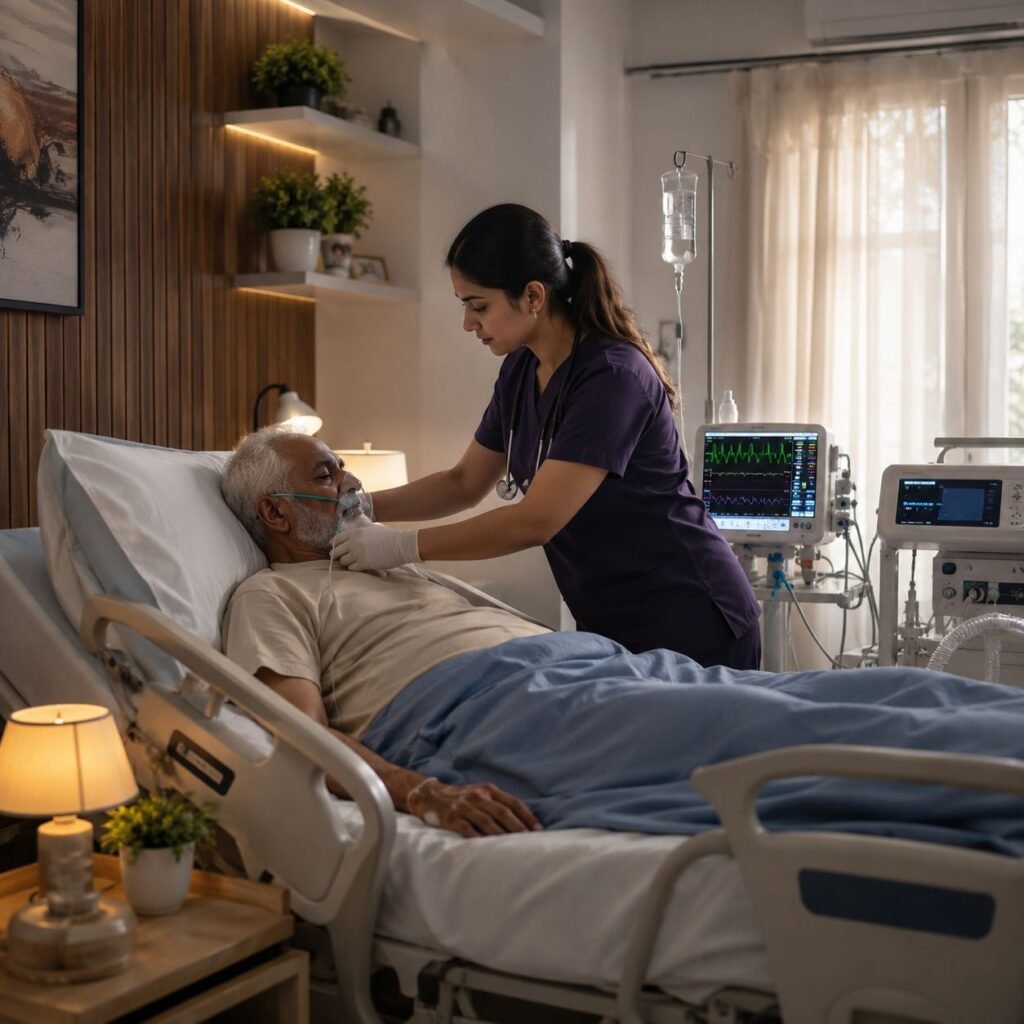
When a family member suffers from a severe illness, prolonged hospital stays can be emotionally draining, physically exhausting, and financially overwhelming. Fortunately, modern healthcare has evolved significantly. Today, setting up an ICU at home allows critically ill patients to receive advanced, hospital-level medical care while surrounded by the comfort and warmth of their family.
Whether recovering from major surgery, managing a chronic critical condition, or undergoing long-term palliative care, an ICU setup at home bridges the gap between high-level medical treatment and familiar home surroundings.
In this guide, we break down everything you need to know about setting up an ICU at home including key equipment, benefits, nursing care, and answer the most frequently asked questions.
What is an ICU at Home?
An ICU at home is a specialized healthcare setup that replicates the infrastructure, technology, and medical monitoring of a traditional hospital Intensive Care Unit (ICU) right inside a patient’s bedroom.
It involves a combination of:
- Advanced Medical Equipment: Ventilators, multipara monitors, oxygen concentrators, and suction machines.
- Specialized Critical Care Nursing: 24/7 dedicated ICU-trained nurses.
- Doctor Supervision: Regular visits or tele-consultations by intensivists, pulmonologists, and general physicians.
- Physiotherapy & Caregiver Support: Personalized rehabilitation routines to assist recovery.
Who Needs an ICU at Home?
An ICU at home is recommended for patients who are medically stable enough to be discharged from a hospital ICU but still require continuous monitoring and high-dependency critical care.
Common conditions that benefit from home critical care include:
- Neurological Conditions: Stroke recovery, traumatic brain injuries, paralysis, or advanced Parkinson’s disease.
- Respiratory Illnesses: Patients requiring long-term tracheostomy care, non-invasive ventilation (BiPAP/CPAP), or invasive mechanical ventilators.
- Post-Operative Recovery: Patients recovering from complex cardiac, orthopedic, or abdominal surgeries.
- Oncology & Palliative Care: End-stage cancer care where comfort, pain management, and dignity are top priorities.
- Geriatric Critical Care: Elderly patients susceptible to hospital-acquired infections (HAIs) who need round-the-clock monitoring.
Essential Equipment Required for a Home ICU Setup
To ensure patient safety and seamless monitoring, a proper home ICU setup requires standard medical-grade machinery tailored to the patient’s specific condition:
- Motorized ICU Bed: Multi-function beds that allow adjustment of head/foot height and prevent pressure sores (bedsores).
- Multipara Monitor: Real-time tracking of vital signs including ECG, blood pressure, pulse rate, oxygen saturation (SpO2), and respiration rate.
- Ventilator or BiPAP/CPAP Machine: Provides critical respiratory support for patients with breathing difficulties.
- Oxygen Concentrator & Cylinder: Ensures a continuous and reliable oxygen supply.
- Suction Machine: Used for clearing airway secretions, especially in tracheostomy patients.
- Infusion & Syringe Pumps: Delivers precise dosages of critical medications and fluids intravenously.
- Infirmary Essentials: Air mattresses (anti-bedsore), nebulizers, and emergency resuscitation kits (AMBU bag).
Major Benefits of Choosing ICU Care at Home
1. Reduced Risk of Hospital-Acquired Infections (HAIs)
Hospitals, by nature, carry a high risk of cross-contamination and antibiotic-resistant infections. Setting up an ICU at home significantly lowers exposure to multi-drug resistant pathogens, speeding up the healing process.
2. Emotional Comfort & Faster Healing
Physical illness takes a toll on mental health. Being near family members, familiar sounds, and personal comforts drastically lowers anxiety and depression, which positively influences physiological recovery.
3. Significant Cost Savings
Hospital ICU beds can be exorbitantly expensive due to room charges, administrative costs, and overheads. Bringing an ICU at home can reduce daily medical expenses by 30% to 50% while maintaining the exact same standard of clinical care.
4. Personalized 1-on-1 Medical Attention
In a busy hospital ICU, one nurse typically handles multiple critical patients. At home, your loved one receives undivided, 1-on-1 attention from a dedicated ICU nurse 24 hours a day.
5. Active Family Participation
Family members can closely observe care routines, interact with doctors, and offer emotional support without being restricted by rigid hospital visiting hours.
How to Set Up an ICU at Home: Step-by-Step
Setting up an ICU room at home requires quick planning and seamless coordination between the treating hospital, family members, and the home healthcare provider.
- Medical Assessment: The treating physician evaluates the patient’s condition to confirm stability for home transfer.
- Room Inspection & Sanitization: Choose a spacious, well-ventilated, and quiet room. The room must be thoroughly sanitized and have multiple grounded electrical outlets.
- Equipment Installation: High-grade medical equipment is delivered, sanitized, installed, and tested before the patient arrives.
- Clinical Staffing Deployment: Specialized critical care nurses and trained nursing attendants are assigned in 12-hour or 24-hour shifts.
- Continuous Care & Monitoring: Daily logs of vital parameters, doctor tele-rounds, and ongoing physical therapy ensure holistic recovery.
Frequently Asked Questions (FAQs)
Q1. Is an ICU at home safe for critically ill patients?
Yes, provided the patient is medically stable as determined by their treating physician. A proper home ICU setup includes real-time vital monitors, emergency backup equipment, and 24/7 care by trained critical-care nurses under doctor supervision.
Q2. How much does an ICU at home cost compared to a hospital?
While costs depend on the exact medical equipment and nursing hours required, an ICU setup at home is typically 30% to 50% cheaper than stay charges in a private hospital ICU.
Q3. Can a patient on a ventilator be managed at home?
Yes. Patients on long-term invasive (tracheostomy) or non-invasive (BiPAP) ventilation can be safely managed at home with a medical-grade ventilator, dedicated ICU nurses, and emergency oxygen backups.
Q4. What happens during an emergency at home?
Home ICU providers establish strict protocols for emergencies. Ventilators and monitors feature audible alarms, and nurses are trained in BLS (Basic Life Support) and ACLS (Advanced Cardiovascular Life Support). In case of clinical deterioration, an emergency ambulance protocol is initiated immediately for hospital transfer.
Q5. How do I choose the right home ICU service provider?
Look for providers that offer calibrated, hospital-grade equipment, certified critical-care nurses, direct doctor supervision, transparent pricing, and 24/7 emergency support.
Conclusion
Choosing an ICU at home offers a compassionate, safe, and cost-effective alternative to prolonged hospitalization. By combining cutting-edge medical technology with personalized care, you can give your loved one the best chance at recovery right where they feel safest, at home.